
Multimodal AEO: how to use images, video, and accessibility to earn visibility in AI search
A practical guide to aligning text, images, video, and accessible semantics so pages are easier to cite in AI answers while also strengthening organic SEO.
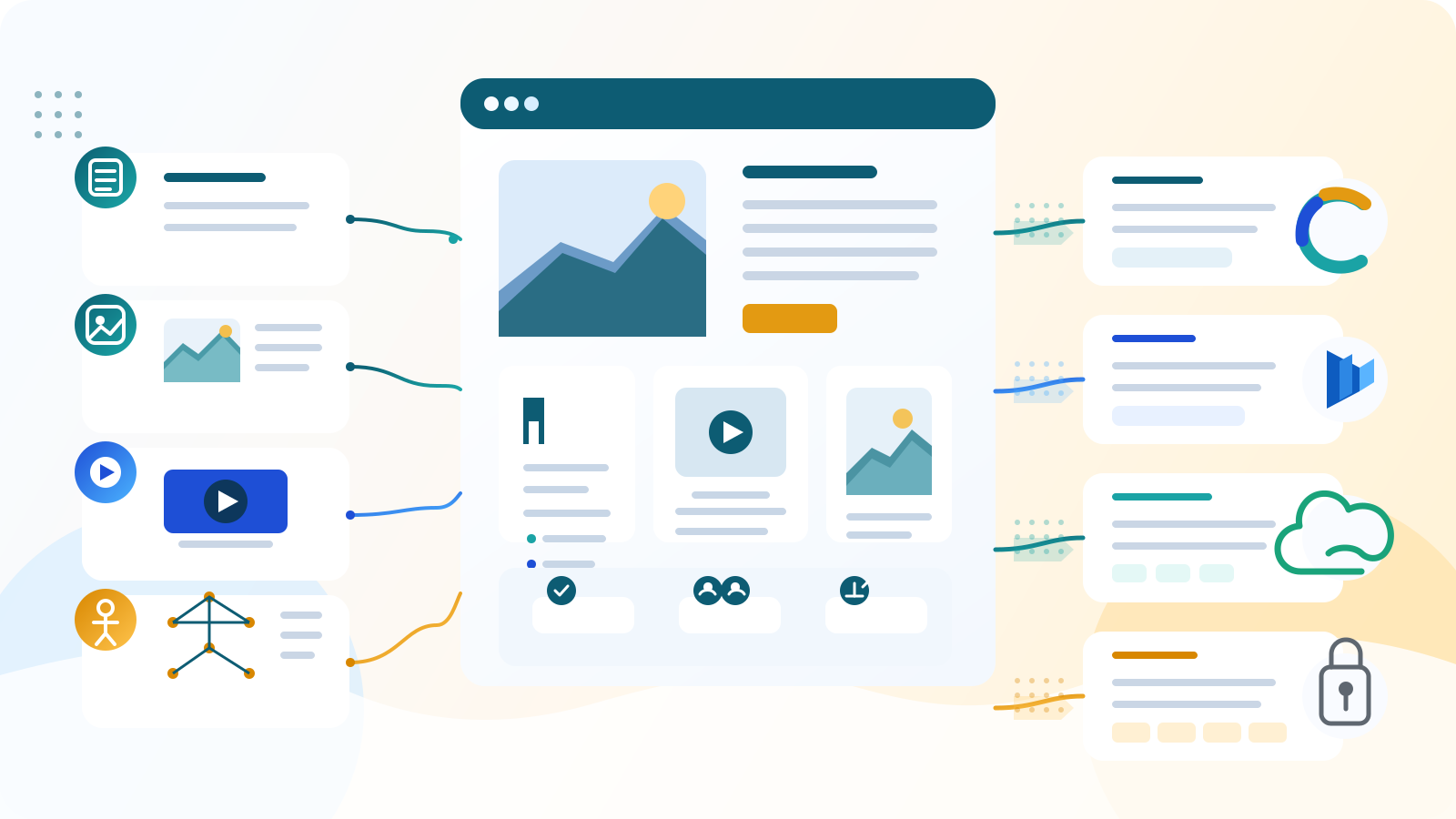
A lot of AEO discussion still treats text as the whole game. That is understandable, but no longer sufficient. Answer engines and agents do not just read headlines and paragraphs. They interpret images, evaluate landing pages, detect video structure, use semantic HTML, and, when needed, cross-check all of that with visual cues. If a page wants to be citable, it is not enough to write well. It has to express the same idea across multiple layers at once.
That is no longer just an informed guess. Google’s new guidance for generative AI features emphasizes unique, useful, easy-to-navigate content and gives specific advice for local, shopping, image, and video content. Bing’s AI Performance guidance recommends improving clarity, structure, evidence, and reducing ambiguity across formats. OpenAI confirms that ChatGPT search traffic can be tracked with `utm_source=chatgpt.com` and that accessible pages are easier for agents to understand. Cloudflare has turned content format and agent readiness into operational signals instead of abstract ideas.
On this site we have already covered how to measure AEO without guessing, how to structure citable content, and why agent-ready websites also improve SEO. This article extends that framework from another angle: how to design multimodal assets that make a page easier for AI systems to understand while also strengthening the site’s broader organic footprint.
Why AEO is no longer only a copy problem
When an AI answer summarizes a service, compares a product, or recommends a source, it rarely relies on a single signal. It may extract primary text, use the image to understand context, read heading structure, identify a table, inspect form and button semantics, or understand video chapters. The more consistent those layers are, the less work the system has to do to reconstruct the page’s intent.
That matters for standard SEO too. A page that explains itself with clear text, properly discoverable images, contextualized video, and semantic HTML is not only more useful for AI systems. It is also more likely to perform well in traditional Google Search, Google Images, Discover, enriched results, and overall user experience. Good AEO does not compete with SEO. It makes SEO more disciplined.
Layer one: images that explain instead of decorate
Google still stresses that images should be discoverable and indexable, and that optimizing the image landing page matters as much as the asset itself. That pushes teams away from two common mistakes: using critical images as CSS backgrounds and pairing strong visuals with pages that barely explain what the image means.
In AEO, a useful image is not just a nice thumbnail. It is a compact explanation of a concept that also exists in the body copy: a process map, a comparison, a methodology diagram, or a metrics view. When the graphic, the `alt`, the nearby heading, and the supporting paragraph all reinforce the same idea, the URL gains semantic density without turning into filler. That is why original editorial diagrams are usually more valuable than generic stock art.
Layer two: video with context and extractable structure
Google supports key moments in video through `Clip` or `SeekToAction`. Beyond the markup itself, the practical lesson is broader: if a video sits on a page without a summary, clear purpose, chapters, or visible relevance to the URL’s intent, it adds little to SEO and little to AEO. If it reinforces an explanation, demonstrates a workflow, or clarifies a comparison, it becomes another reliable extraction surface.
Not every article needs video. But whenever video is present, it helps to create a parallel reading path in text: a strong introduction, clear sections, visual support, and a landing page that stays tightly aligned with the same topic. That kind of useful redundancy helps humans and also helps systems verify what the asset actually represents.
Layer three: accessibility and semantics for agents
This is where many websites still lag. OpenAI explains that ChatGPT Atlas understands buttons, menus, and forms better when pages use descriptive roles, labels, and states. web.dev goes further by reminding us that agents combine screenshots, HTML, and the accessibility tree. In other words, it is not enough for something to look interactive. It needs to behave like an interactive element in the document structure too.
For commercial websites, that has direct consequences. A CTA implemented as an ambiguous `div`, a form without associated labels, overlays that cover actionable elements, or aggressive layout shifts create friction for users, search engines, and agents alike. Using semantic HTML, linking `label` and `input`, keeping tap targets clear, and preserving stable hierarchy improves cross-system comprehension. It is accessibility, but it is also retrieval quality.
Layer four: reduce ambiguity across formats
Bing states this especially well: align text, images, and video so they represent the same concepts, products, or entities. That sounds obvious, but many pages still do the opposite. They headline one promise, show an ornamental image that adds no context, and embed a video about a different subject. When that happens, the page forces the system to decide which signal matters most, and that ambiguity weakens citation potential.
The solution is not to flatten everything. It is to coordinate formats. If a page is about an AI visibility audit, the main image should reinforce observability, source flows, or decision paths. If it is about local service pages, the diagram should reinforce entity, coverage, and proof. If it includes video, the video should deepen the same problem rather than switch to generic promotion. Consistency compounds clarity.
Layer five: think about how content is served too
Cloudflare’s recent work is useful here because it turns served content format into a visible metric. Its Content Format insights help explain what kinds of resources AI systems request and what the origin actually serves back. Combined with Agent Readiness, that encourages a better discipline: do not stop at the visual design of a page. Review how easy its primary information is to extract, what the bot sees, and whether the technical signal supports the editorial one.
That fits neatly with Google’s broader advice to ignore magical AEO shortcuts and keep technical structure clean. There is no need to chase hacks. What matters is that images are discoverable, the page is accessible, videos are contextualized, key information is not hidden, and the URL serves its content consistently.
How to turn this into an actionable backlog
- Replace purely decorative hero assets with original visuals that summarize a core idea.
- Make sure important images use `<img>` instead of relying on CSS backgrounds for meaning.
- Add descriptive `alt` text and nearby copy that explain the same concept without becoming repetitive.
- When a page includes video, summarize its purpose in text and add chapters or key moments where it makes sense.
- Fix ambiguous buttons, forms, and menus with semantic HTML, linked labels, and accessible states.
- Check that text, image, video, and CTA all support the same search or answer intent.
- Measure generative exposure, citations, ChatGPT referrals, and technical access as one operational view.
What standard SEO gains from this
The upside does not stop at AI visibility. A page with stronger support visuals, better semantics, contextualized video, and less ambiguity usually earns more logical internal linking, more chances to appear in visual surfaces, clearer topical understanding by URL, and a less fragile mobile experience. In practical terms, it improves the page’s ability to answer, rank, and convert.
This also strengthens strategic site coverage around terms such as multimodal AEO, image SEO, video SEO, web accessibility, agent readiness, AI search, AI Mode, and citable pages. That fits naturally with core assets like what AEO is, the methodology, resources, and the AI visibility audit. The internal graph becomes more useful for readers and broader for search engines.
If a page still requires the engine to guess what each format means, it is not ready to compete seriously for AI answer visibility.
Quick checklist for a more citable multimodal asset
- Every primary image should explain something, not just decorate.
- Every video should have textual context, a clear purpose, and usable structure.
- Every important interaction should be described with semantic, accessible HTML.
- Every format on the URL should reinforce the same editorial or commercial promise.
- Every improvement should be measured through visibility, citation, qualified visits, and real technical access.
That is probably the next practical step in serious AEO. Less obsession with isolated tricks and more effort in assets that a human, a search engine, and an agent can interpret with the same ease. If an agency needs to turn that principle into repeatable deliverables across clients, our white-label AEO service and AI visibility audit can help identify which pages already have a strong multimodal base, which are still too ambiguous, and what technical or editorial priority should come next.
References
- Google Search Central: Optimizing your website for generative AI features on Google Search
- Google Search Central Blog: Introducing Search Generative AI performance reports in Search Console
- Google Search Central: Google image SEO best practices
- Google Search Central: Video structured data
- Bing Webmaster Blog: Introducing AI Performance in Bing Webmaster Tools Public Preview
- OpenAI Help Center: Publishers and Developers FAQ
- web.dev: Build agent-friendly websites
- Cloudflare Changelog: Tools to prepare your site for the agentic Internet
- Cloudflare Blog: Introducing the Agent Readiness score
- Adobe Digital Insights: Q3 AI Traffic Trends Report