
How to measure AEO without guessing: Search Console, Bing, ChatGPT and logs
A practical guide to measuring answer-engine visibility with real signals: Google generative AI impressions, Bing citations, ChatGPT referrals and crawl-quality logs.
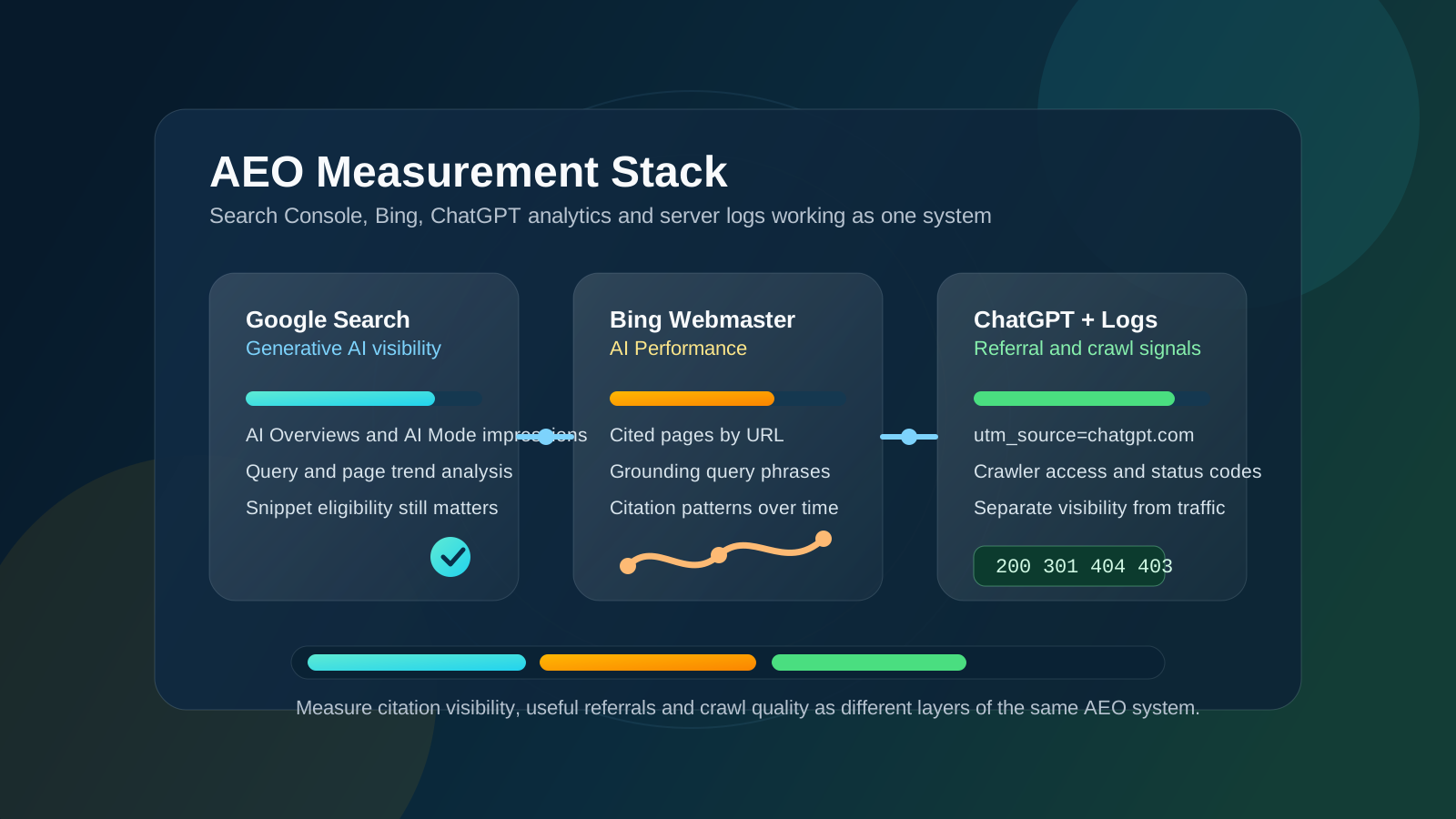
One of the biggest problems in AEO is that too many teams still try to measure it with weak evidence: a single screenshot from ChatGPT, a casual mention in Copilot, or a vague feeling that "AI must be sending something." That is not enough to support investment decisions or explain outcomes to clients. The good news is that the measurement base is now stronger. Google has started separating generative-AI visibility in Search Console, Bing offers AI Performance with cited pages and grounding query phrases, OpenAI documents a way to identify ChatGPT referrals, and logs remain the layer that confirms whether agents can actually access your URLs.
If you need the broader frame first, what is AEO covers the discipline. This article stays operational: how to build a useful measurement system, what each source can tell you, and which mistakes to avoid if you want the post itself to strengthen the portal's SEO and AI visibility.
Do not force every signal into one metric
AEO is not a single channel. At minimum, there are four separate layers to track. The first is visibility inside generative search experiences. The second is whether specific pages are cited as sources supporting answers. The third is the useful traffic those experiences send you. The fourth is the technical access that makes all of the above possible. If you mix those layers together, you will misread almost every signal.
- Visibility: how often your pages appear in generative search experiences such as AI Overviews or AI Mode.
- Citation: which exact URLs are reused as sources or supporting evidence.
- Referral: which visits actually arrive from answer engines and where they land.
- Technical access: whether crawlers, search bots and user agents receive the correct production responses.
Google Search Console now offers an explicit AI signal
The most important recent change is that Google no longer forces site owners to infer the generative layer entirely from the general performance report. Search Console now includes a dedicated view for impressions inside generative Search features, including AI Overviews and AI Mode. That does not make AEO fully solved, but it removes one of the most common excuses: there is now an official signal for tracking movement in that surface instead of relying only on manual observation.
The correct interpretation matters. That visibility does not replace classic SEO; it confirms it. Google's own generative-search guide says a page must be indexed and eligible to appear with a snippet in Search. In practical terms, if crawling, indexation, architecture, snippets or content clarity are weak, the generative layer will not hold either. That is why it makes sense for our portal to connect this piece to the methodology and the AI visibility audit: measuring without fixing the technical base only creates prettier dashboards.
Bing AI Performance makes AEO much more actionable
The other genuinely useful shift is AI Performance in Bing Webmaster Tools. Here the change is more tangible for content teams: you are no longer looking only at whether a domain appears, but which pages are cited and for what kinds of queries. Grounding query phrases help connect a specific URL to the type of informational or comparative need the engine is trying to satisfy. That moves optimization much closer to real editorial decisions.
If a page is cited often, that usually signals enough focus, structure and utility for the content to be reused. If a URL is indexed but rarely supports answers, it may need clearer structure, better evidence, cleaner definitions, stronger tables or tighter alignment with intent. That is a far more serious way to prioritize content than chasing generic keywords without context. It also fits transactional assets on a site like ours, such as the white-label AEO page, where the goal is not only to earn clicks but to become a trustworthy source in provider-evaluation answers.
ChatGPT is not just something to observe; it can be tracked
There is still too much mystical thinking around ChatGPT. OpenAI now documents two points worth using. First, if you want your content included in summaries and snippets, you should not block OAI-SearchBot. Second, referral traffic from ChatGPT search includes the `utm_source=chatgpt.com` parameter, which means you can isolate that source in analytics. This does not mean AI traffic will always be large or miraculous. It means something more useful: you can stop arguing in the abstract and start looking at sessions, landing pages and real conversions.
This is where restraint matters. Small referral volume does not invalidate AEO if the answer layer cites you. And more visits from AI do not prove business value if they land on irrelevant pages. The right question is which pages receive that traffic and whether they are ready to continue the task the user already started inside the answer engine: comparing options, understanding the method, evaluating a provider or requesting an audit. That is why this article intentionally links to the methodology and commercial service pages: it strengthens the internal routes that search engines, agents and users can actually follow.
Logs remain the layer that separates theory from reality
No external dashboard replaces logs or, at minimum, reliable server- or CDN-level measurement. That is where you confirm whether Googlebot, OAI-SearchBot, Claude-SearchBot, ChatGPT-User or other relevant agents get 200 responses where they should, whether they hit unexpected 403s or 404s, or whether a security layer introduces contradictions between robots rules, WAF behavior and actual responses. Production verification prevents a site from looking active in aggregate tools while teaching crawlers that the domain is full of noise, duplicates or broken paths.
Useful changes are happening here too. Cloudflare has expanded AI Crawl Control with richer metrics, content-format insights, response-status visibility and tooling aimed at the so-called agentic Internet. There is no need to turn that into tool worship. The practical lesson is simpler: if you do not know what agents actually receive in production, your AEO measurement is incomplete.
The minimum dashboard that does make sense
- Google Search Console generative-AI impressions to track trend lines and identify which page groups gain or lose generative visibility.
- Bing Webmaster Tools cited pages and grounding query phrases to prioritize structural and editorial improvements.
- An analytics segment for `utm_source=chatgpt.com`, with attention to landing pages and useful conversions.
- Logs or edge analytics to review HTTP status, crawl frequency and blocks affecting the bots and agents that matter.
- Your own prompt-portfolio measurement to connect those inputs with mention rate, citation rate and share of voice.
What not to do
- Treat a single chat appearance as proof of stable visibility.
- Confuse generative impressions with business value if you do not inspect the cited or landing page.
- Block bots reflexively and then wonder why you disappear from AI experiences.
- Assume one article can fix visibility without strong architecture, internal linking and service pages.
- Publish generic informational content disconnected from the pages that actually convert.
How this also helps the portal's own SEO
A post about AEO measurement can work as both an informative asset and a ranking asset when it is integrated into a coherent internal network. That means linking the core concept, methodology, audit, lab and commercial offer; covering terms such as AEO, AI SEO, ChatGPT search, AI Overviews, Bing AI Performance and AI visibility measurement; and writing precisely enough to be citable. This is not about forcing keywords into the page. It is about publishing a document that search engines and answer engines can understand, reuse and connect to the rest of the domain.
The best AEO metric is not a pretty screenshot; it is a system that connects visibility, citation, useful traffic and technical access.
That is the standard worth aiming for now. Less folklore, more traceability. If an agency wants to build that system without creating an internal answer-engine team from scratch, our white-label AI visibility audit is the fastest way to establish a baseline, find blockers and turn the AEO conversation into a measurable process.
References
- Google Search Central Blog: Introducing Search Generative AI performance reports in Search Console
- Google Search Central: Optimizing your website for generative AI features on Google Search
- OpenAI Help Center: Publishers and Developers FAQ
- Bing Webmaster Blog: Introducing AI Performance in Bing Webmaster Tools Public Preview
- Cloudflare Docs: AI Crawl Control changelog
- Search Engine Land: What 13 months of data reveals about LLM traffic growth and conversions