
Agent-ready websites: the AEO layer that also improves your SEO
A practical guide to turning agent readiness into a real AEO and SEO advantage through access, canonicals, structured data, markdown delivery, response status and measurement.
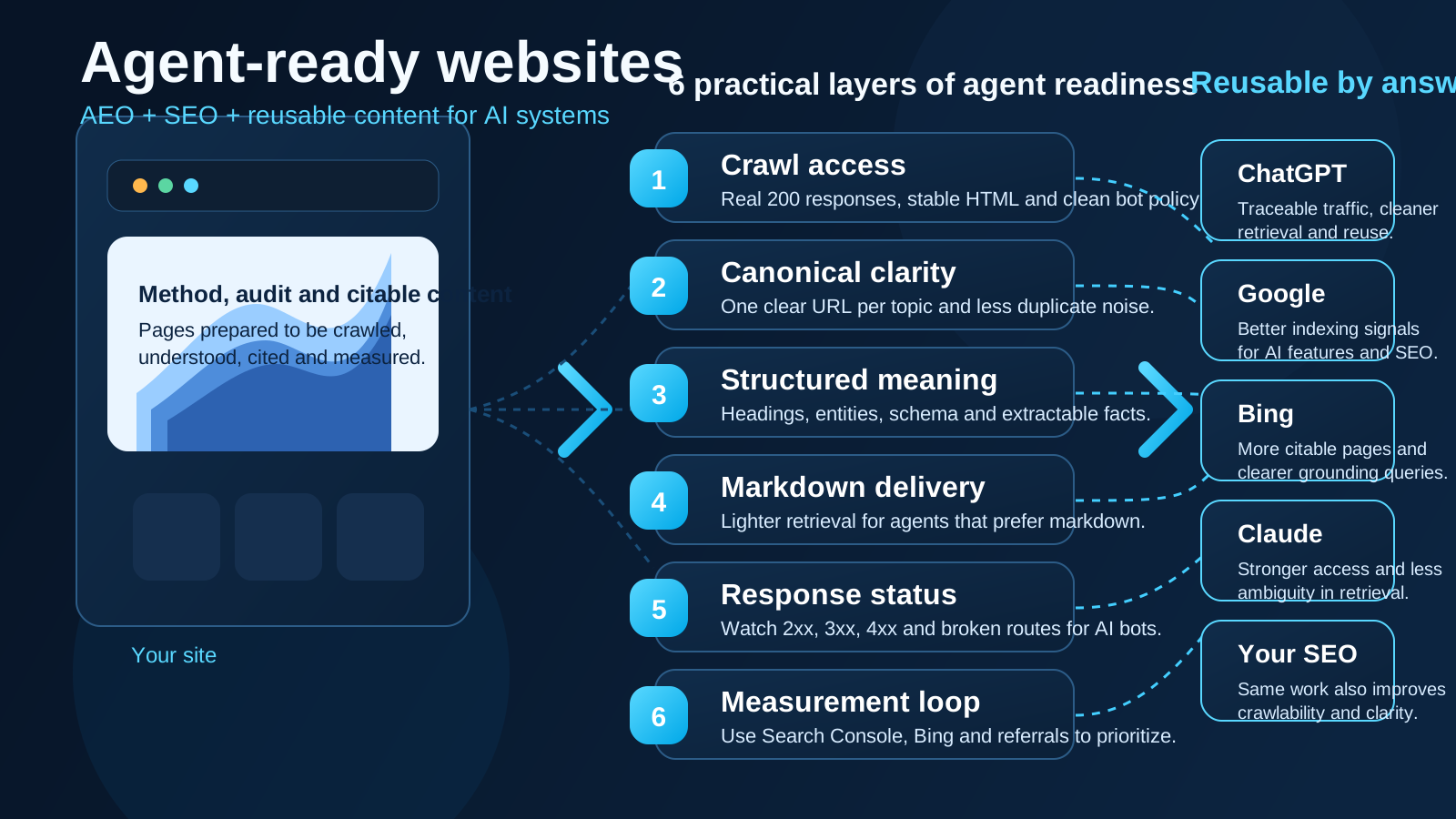
For months, much of the AEO conversation has revolved around one question: how do you appear in generated answers from Google, Bing, ChatGPT, Claude or Perplexity? The question still matters, but it is no longer enough. It is not only about appearing. It is also about making your site easy for bots, crawlers and agents to retrieve, interpret, compare and reuse. That is where a layer deserves much more attention: agent readiness.
The underlying reason is simple. Google keeps saying that optimizing for its generative experiences is still, to a large extent, serious SEO: well-organized content, less duplication and a good page experience. Bing now shows citations, cited pages and grounding queries in AI Performance. OpenAI makes ChatGPT search traffic traceable with `utm_source=chatgpt.com`. And Cloudflare has added new agent-readiness and bot-response signals in Radar and URL Scanner. Together, these changes point in the same direction: a site that works for answer engines also needs to be prepared for agents.
If you want the base context first, we have already covered what AEO is, how to measure it without guessing and how to turn Search Console and Bing AI Performance into a backlog. This piece focuses on the next layer: how to prepare a website so that visibility becomes more reusable and more defensible.
What it really means for a site to be agent ready
It does not mean chasing a trendy score or installing a magic patch. It means reducing friction across the full path from a URL to an answer: discovery, access, interpretation, fact extraction, citation and measurement. If an agent finds a page but receives unstable HTML, ambiguous canonicals, duplicated blocks, hidden facts or 4xx responses, reuse becomes less likely. If it receives a clear, consistent and measurable page, the odds of reuse or citation go up.
That is why agent readiness should be treated as an operational discipline, not as another slogan. It is a concrete way to prioritize technical and editorial work that already mattered for SEO, but now matters even more because automated retrieval and synthesis are becoming central to search.
Layer one: real access for crawlers and agents
The foundation remains the least glamorous and the most decisive. A strategic URL should return a real 200, stable HTML and no contradictory policy for the bots you actually want to allow. This affects Googlebot, Bing crawlers, OAI-SearchBot and the wider set of agents that depend on reliable retrieval. If access is broken, everything else becomes optimization on top of damaged ground.
- Check for a real 200 response, not a soft 404 or broken HTML.
- Separate search, training and retrieval decisions when that distinction matters.
- Avoid security or WAF layers that silently block legitimate access.
- Verify the production URL, not an idealized local version.
Layer two: canonical clarity and less duplicate noise
Google recommends reducing duplicate content, and Bing has been explicit that duplication blurs signals for AI search visibility as well. This is not only an indexing issue. When several URLs compete to represent nearly the same idea, the system has more work to decide which one to understand, cite or surface. Sometimes it ends up reusing the wrong version. Or none.
On a specialist site like Blobic, that requires editorial discipline. Methodology should live on its own core page. The audit should have its own page. The white-label service should as well. Blog posts should expand, connect and cover specific angles, not duplicate the same argument under different titles. That cleanup improves AEO and strengthens classic SEO at the same time.
Layer three: structured meaning and extractable facts
Agents perform better when a page makes it obvious which question it answers, which entity it describes, which process it explains and which facts it provides. That requires clear titles, useful headings, tables when appropriate, lists when they help and structured data that matches the visible page. The goal is not robotic writing. The goal is better signal separation.
This is where citable content intersects with agent readiness. A page that is easier to extract is usually also easier to compare, link and cite. And when Article, FAQPage, Service or Organization markup genuinely matches the visible content, it reinforces semantic interpretation without inventing anything.
Layer four: lighter formats and negotiable delivery
One of the most interesting recent developments is Cloudflare's Markdown for Agents. Precision matters here: it is not a magical ranking lever. But it does point to an important direction. If an agent can request a lighter markdown version with less presentation noise and preserved metadata, retrieval becomes more efficient. That lowers technical friction and processing cost.
The practical lesson is not 'convert everything to markdown and you are done.' The practical lesson is to design pages whose content still works when decoration, scripts and ornaments are stripped away. If the useful answer survives cleanly in a simpler format, the page is usually better built for SEO, accessibility and reuse as well.
Layer five: response status and observability
Cloudflare Radar now makes it easier to see how sites respond to AI bots and crawlers, including HTTP status distributions and agent-standard signals. That matters because it moves the conversation away from theory. If a meaningful share of bot responses lands in 403, 404 or 5xx territory, the problem is no longer an editorial guess. It is a visible technical bottleneck. Agent readiness without observability is just a slogan.
For a services site, that observability should feed real decisions: which templates behave worse for specific bots, which URLs deserve priority review, which blocks are served unstably and where a technical fix could unlock an important commercial page.
Layer six: measurement closes the loop
The work is not finished when a page merely looks more prepared. It is finished when you can measure its behavior more clearly. Search Console helps you see generative exposure. Bing AI Performance shows citations and grounding queries. OpenAI leaves traceable ChatGPT search referrals. An agent-ready site does not only serve content better; it also helps you learn which URLs are gaining reuse, which remain ambiguous and which changes actually move the business.
That is why agent readiness does not compete with AEO. It makes AEO more rigorous. Instead of arguing about supposedly secret factors, it forces you to connect access, structure, formats and metrics to a defensible work queue.
Why this also improves SEO
Because almost all of the work above overlaps with fundamentals that already mattered for search: better page experience, less duplication, clearer architecture, better-defined entities and less crawl friction. The difference now is that the benefit does not stop at traditional ranking. It also affects how the site is read, summarized and cited by answer systems.
On a site like this one, the editorial effect is also doubled. A post like this reinforces terms that fit the project: AEO, technical SEO, agent readiness, citable content, AI bots and answer-engine visibility. And by connecting naturally to the methodology, the AI visibility audit and white-label AEO, it improves the site's internal graph as well.
Short checklist to audit agent readiness
- One clear primary URL per topic, without fuzzy canonicals.
- Stable 200 responses for the bots and agents that matter to your strategy.
- Visible content that is easy to extract: definitions, processes, tables, limits and proof.
- Structured data aligned with the real visible page.
- Less duplication across core pages, blog posts and service landings.
- Observability for HTTP statuses and bot-facing behavior.
- Metrics tied to visibility, citation and business value, not only impressions.
An agent-ready site is not the one that talks most loudly about AI. It is the one that puts the fewest obstacles between a useful question and a reusable answer.
That is the standard worth adopting now. Less folklore, more real preparation. If an agency needs to apply this approach across several clients without building a full internal team, our white-label AI visibility audit helps identify access blockers, structural ambiguity, citable-content opportunities and technical priorities before months are lost on scattered actions.
References
- Google Search Central: Optimizing your website for generative AI features on Google Search
- Google Search Central Blog: A new resource for optimizing for generative AI in Google Search
- Bing Webmaster Blog: Introducing AI Performance in Bing Webmaster Tools Public Preview
- Bing Webmaster Blog: Does Duplicate Content Hurt SEO and AI Search Visibility?
- Cloudflare Changelog: AI Insights updates on Cloudflare Radar
- Cloudflare Changelog: Agent Readiness scores now available in URL Scanner via the Cloudflare Dashboard
- Cloudflare Fundamentals: Markdown for Agents
- OpenAI Help Center: Publishers and Developers - FAQ