
Citable content for AEO: how to structure pages AI can understand and cite
A practical guide to building pages that are easier to cite in Google, Bing, ChatGPT and Claude through semantic clarity, evidence, deduplication and agent-friendly formats.
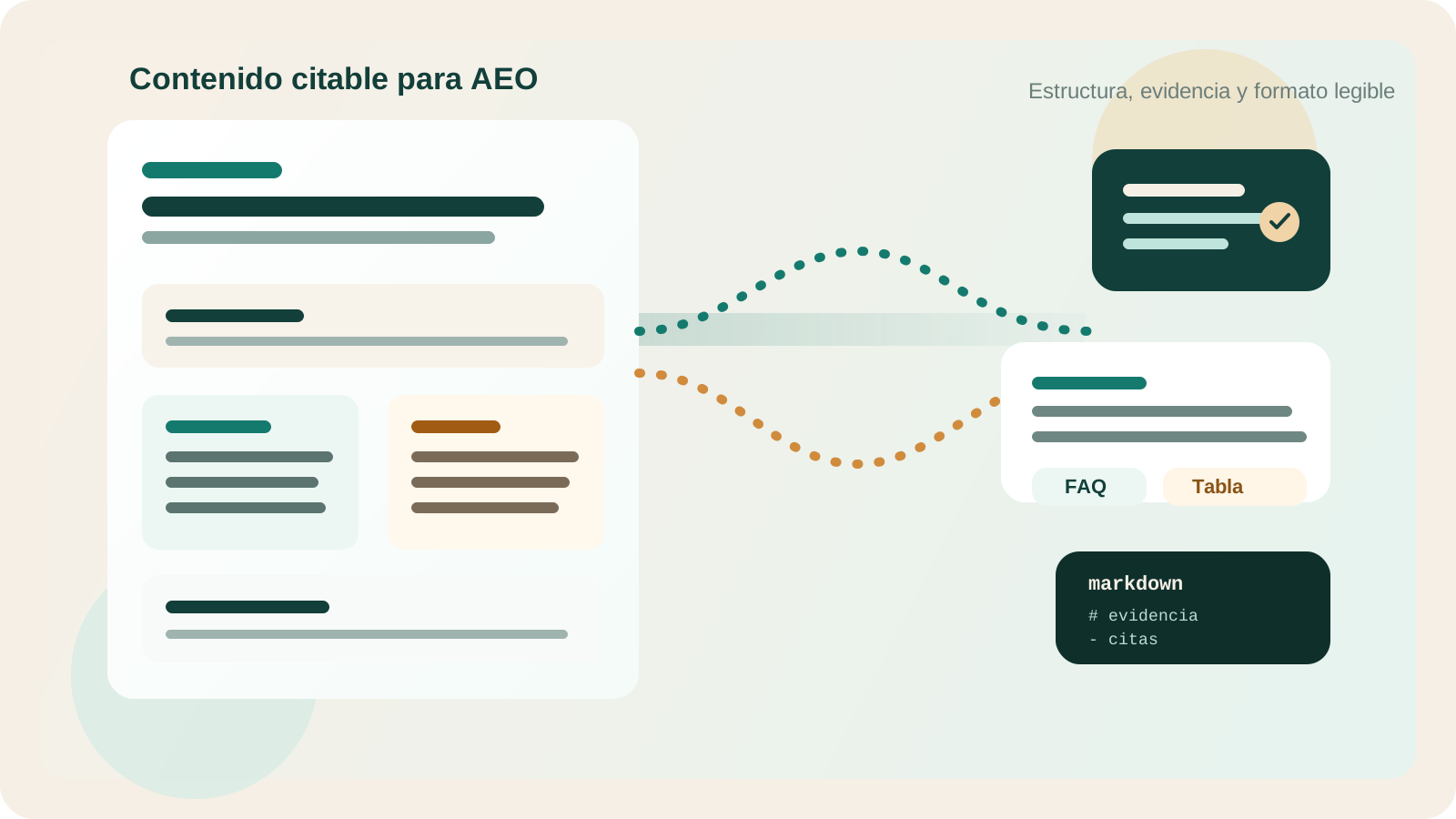
AEO now has better measurement, clearer citation signals and more transparency across answer surfaces. The next bottleneck is simpler: many pages are still hard to reuse. Not because the topic is weak, but because the content arrives mixed, ambiguous, duplicated or buried in awkward formats. If you want an answer engine to understand and cite you, publishing more is not enough. You need to publish in a more legible way.
Google keeps saying there is no secret optimization layer beyond serious SEO: a page needs to be indexable and eligible for a snippet. Bing now shows which URLs get cited and for which grounding queries, and its own guidance pushes in the same direction: clarity, structure, evidence and freshness. Even emerging tools such as Cloudflare's Markdown for Agents point to the same underlying idea. The useful work is not decorating a page with new acronyms; it is making the right answer clearer, more verifiable and easier to extract.
If you want the surrounding context first, we have already covered what AEO is, how to measure it without guessing and how crawler policy should be separated. This article stays on the editorial and structural layer: how to turn a normal page into a more citable page.
Start by solving a task, not by padding a keyword
The pages that get reused best usually solve one clear task: define, compare, choose, verify, estimate or explain a process. When a URL tries to cover too many intentions at once, the answer gets soft. For AEO, that reduces the chance that an engine will use the page to support a specific response.
- A strong AEO page usually has one recognizable goal.
- The title, introduction and headings should make the target question obvious.
- Sections should separate definition, process, comparison, pricing, limits or FAQs into distinct blocks.
- If the intent is transactional or evaluative, the page should not drift into a generic essay.
Semantic clarity matters more than inflated prose
Microsoft has been repeating a very concrete recommendation for AI search: use clear headings, tables, FAQs and claims backed by data or sources. That makes sense. An answer engine works better when it can locate a claim, see which block it belongs to and compare it with other evidence. Bloated copy, endless paragraphs and empty marketing phrases create noise, not authority.
That does not mean writing like a robot. It means reducing ambiguity. If you offer white-label AEO, say that plainly. If an audit includes prompt mapping, a baseline, citations and a roadmap, list it. If a service is for agencies, do not hide that behind a polished slogan. AI does not reward elegant vagueness; it rewards information it can isolate, compare and restate.
Make the facts that matter visibly extractable
Many websites contain the right information, but expose it badly. Indicative pricing buried in a PDF. Plan differences hidden in tabs. Geographic coverage mentioned once in the footer. Use cases scattered across several nearly identical pages. All of that weakens extraction. If a claim matters for the business or for vendor evaluation, it should appear in visible text, near the context that explains it, and in wording that is easy to cite.
- Turn comparisons into real tables when it helps.
- Expose definitions and limits in visible text, not only inside collapsed UI.
- Keep service names, entities, locations and relationships consistent.
- Support important claims with proof, examples or sources whenever possible.
Deduplication helps both SEO and AEO
Bing has been fairly explicit that duplicate or heavily overlapping content reduces clarity for both SEO and AI experiences. The reason is not hard to see. If several URLs say almost the same thing with fuzzy canonical signals, the system has more work to decide which version best represents your position. Sometimes it ends up citing a weaker page, an outdated version or none at all.
For a site like Blobic, that requires editorial discipline. One core page to explain the method. Another for the audit. Another for the white-label service. Blog posts should expand or connect, not rewrite the same argument with slightly different phrasing. When every URL has a clear function inside the site, you improve crawlability, interpretation and citation probability at the same time.
Structured data helps, but only when it matches the visible page
Google keeps the same rule it has always had: structured data helps when it correctly describes what the user actually sees. It does not replace content, and it does not rescue a confusing page. But when Article, FAQPage, Organization, LocalBusiness or Service markup aligns with visible copy, it reinforces semantic interpretation and reduces contradictions.
The sensible practice is simple: use schema to reinforce real entities, questions, services and relationships; avoid marking up content that barely exists on the page; and check that titles, descriptions, FAQs and important claims do not conflict across visible HTML, metadata and JSON-LD.
The emerging layer: markdown and agent-friendly formats
This is where a genuinely interesting new technique appears. Cloudflare has launched Markdown for Agents, which converts HTML into markdown through content negotiation while preserving useful metadata such as frontmatter and JSON-LD. It should not be sold as a ranking trick, because it is not one. But it does point to an important trend: agents work better when content structure is clean, predictable and lightweight.
The same goes for files like `llms.txt`, well-maintained sitemaps and pages that expose their hierarchy clearly. None of those layers replaces useful content. What they do is reduce technical friction and ambiguity. If the page is already good, they help that quality travel better into search engines, assistants and agents.
Do not block citation by accident
The best page in the world still fails if the relevant bots or agents cannot access it properly. Google reminds site owners that eligibility for AI Overviews or AI Mode depends on the same foundation as Search. OpenAI separates OAI-SearchBot from GPTBot. Anthropic distinguishes Claude-SearchBot, ClaudeBot and Claude-User. In practice, a citable page also needs a coherent access policy. If you block retrieval, snippets or useful crawling, editorial structure will not save you.
That is why this piece should connect to the AI visibility audit, the methodology and the white-label AEO page. The blog informs, but it should also lead toward the transactional and methodological URLs that prove delivery capability.
Short checklist for a more citable page
- One clear primary intent visible from the title.
- Headings that separate definition, process, comparison, evidence and FAQs.
- Key facts exposed in text, tables or lists that are easy to extract.
- One main URL per topic, with duplication kept to a minimum.
- Structured data consistent with visible content.
- Correct access for the crawlers and agents that matter to your strategy.
- Internal links toward related methodology, service and conversion pages.
In AEO, a citable page is not the one that promises the most. It is the one that separates signal from noise most clearly.
That is the useful standard right now. Less obsession with secret factors, more work on making pages easy to crawl, understand, compare and cite. If an agency needs to apply this approach across several clients without building an internal answer-engine team from scratch, our white-label AI visibility audit is the fastest way to identify which pages are already reusable, which ones remain ambiguous, and which editorial or technical priorities should come first.
References
- Google Search Central: AI features and your website
- Google Search Central: Optimizing your website for generative AI features on Google Search
- Google Search Central Blog: A new resource for optimizing for generative AI in Google Search
- Bing Webmaster Blog: Introducing AI Performance in Bing Webmaster Tools Public Preview
- Microsoft Advertising: Optimizing Your Content for Inclusion in AI Search Answers
- Bing Webmaster Blog: Does Duplicate Content Hurt SEO and AI Search Visibility?
- Cloudflare Fundamentals: Markdown for Agents
- OpenAI docs: Overview of OpenAI Crawlers
- Anthropic Help Center: Does Anthropic crawl data from the web, and how can site owners block the crawler?