
AEO for entities: how to strengthen proof, sources, and citations so AI can trust your site
A practical guide to turning a website into a more reusable source for answer engines through first-party proof, entity signals, external sources, and real measurement.
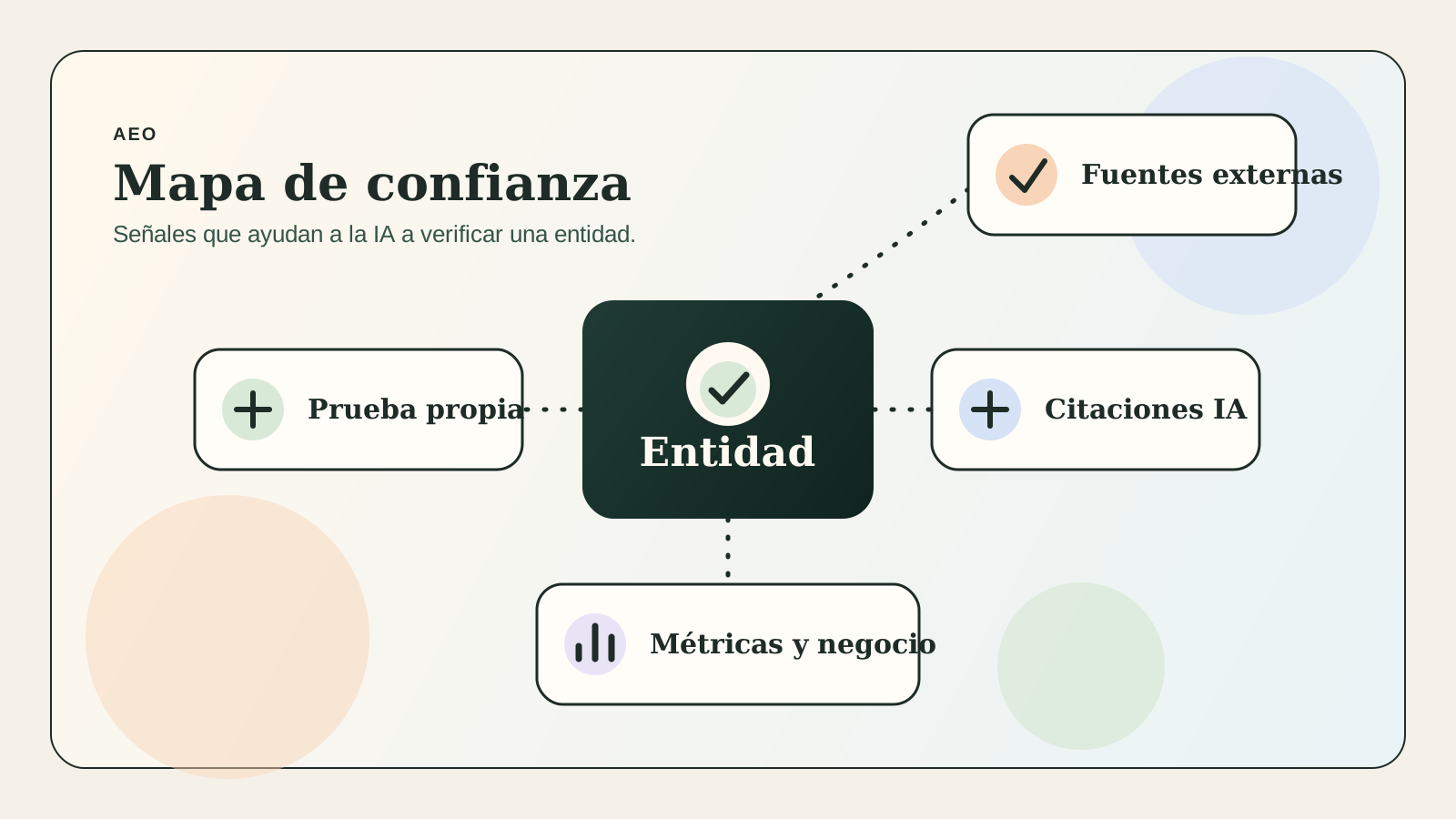
For a while, much of the AEO conversation has focused on content structure and technical accessibility. Both still matter, but another layer is becoming more important: the trust an entity projects when AI systems compare what your site says with what they find elsewhere. A page can be well written and still underperform if it lacks enough proof, if its entity signals are ambiguous, or if its claims do not find reasonable external support.
Recent platform changes reinforce exactly that point. Google now makes it clearer that visibility in AI Overviews and AI Mode still depends on serious SEO, unique content, and useful pages, while explicitly warning against chasing special files such as `llms.txt` for Google. Bing already shows which URLs earn citations, which grounding queries connect to them, and how that reuse changes over time. OpenAI lets publishers isolate referral traffic from ChatGPT with `utm_source=chatgpt.com`. Cloudflare has turned agent readiness and served content format into visible audits. And Adobe continues to show that AI-sourced traffic is not just growing, but also keeps an engagement advantage.
On this site we have already covered how to measure AEO without guessing, how to structure citable content, how to interpret Google's new generative reporting, and how to align formats for multimodal AEO. This article extends that framework from another angle: what makes a website not just readable, but trustworthy and reusable when an engine needs to validate an entity before citing it.
Why entity trust matters so much in AEO
Answer engines do not behave like linear readers who accept one page on its own. They cross-check signals. They compare promises, verify whether the entity is described consistently across different surfaces, and favor assets that reduce verification effort. When a website clearly states who delivers the service, for which kind of client, with which method, with what proof, and with what next step, it becomes much easier for the system to use that page as answer support.
That also improves standard SEO. A better-defined entity usually leads to better titles, better service pages, stronger internal linking, clearer semantics, and less duplication. In other words, entity trust work for AEO does not create a separate line from SEO. It forces SEO to be more verifiable.
Layer one: first-party proof that does not sound like empty promotion
Google keeps stressing that content that performs well in generative experiences tends to be unique, useful, and non-commodity. In practice, that means replacing generic rhetoric with proof. Clear methodologies, comparisons, cases, service limits, work criteria, real FAQs, and decision examples are far more reusable than pages that promise results without explaining where they come from.
For a site like Blobic, that proof can live across the methodology, the AI visibility audit, and posts that break down metrics or operating decisions. The key is making sure commercial copy is not isolated from the evidence. If the promise lives on one URL and the proof on another disconnected one, the system has to reconstruct too much context.
Layer two: consistent entity signals inside the site itself
This is where many seemingly solid websites still fail. They talk about AEO, GEO, AI SEO, and audits, but do not make it clear whether those are the same service, different brands, separate teams, or competing pages. An AI-ready entity needs consistency across naming, navigation, services, breadcrumbs, structured data, authorship, forms, and commercial claims. It does not need to sound rigid. It does need to sound unambiguous.
It also helps to review the relationship between informational and transactional pages. If a post discusses AI citations, it should naturally lead into the assets where that capability becomes concrete: white-label AEO, the audit, the method, or relevant cases. That continuity is not just conversion work. It is part of entity comprehension.
Layer three: external sources that confirm what your website claims
Your own site is not always enough. Google reminds site owners that its systems can surface what is being said about products and services across the web, while Bing makes clear that citation depends on how useful an asset is as a source. That makes the external layer decisive: credible directories, associations, media, professional profiles, published cases, partners, technical repositories, or sector mentions that help validate that the entity exists, operates, and knows what it is talking about.
This is not about chasing artificial mentions or manufacturing noise. Google explicitly warns against that. It is about building a clean, verifiable source graph. If an agency claims to lead AEO work for clients, it should be able to support that through methodology pages, coherent corporate presence, relevant local or vertical signals, and a reasonable external footprint. AI systems trust better when they do not have to resolve conflicting versions of the same story.
Layer four: pages designed to be cited when comparison is needed
Bing AI Performance offers a practical lesson here: being indexed is not enough; what matters is which pages get cited and for which grounding queries. That favors assets that resolve concrete comparisons, definitions, and evaluations. Clear service pages, methodology frameworks, honest comparisons, FAQs with limits, and posts that connect metrics to action tend to perform better as answer support than inflated, vague articles.
A serious AEO team should review which URLs it actually wants to become sources. A generic homepage? An article with no author and no proof? Or a page where the entity is well defined, the problem is tightly scoped, and the next logical step is obvious? The more precise the page utility, the easier it becomes for a system to reuse it.
Layer five: technical access and served format without friction
Editorial trust does not compensate for weak access. Google still requires pages to be indexable and eligible for snippets. Cloudflare adds another useful layer by exposing HTTP statuses, content formats, and agent readiness signals. If a strategic URL returns blocks, muddy HTML, weak canonicals, or inconsistent responses depending on the bot, the entire trust chain weakens. The entity may be well explained, but not well retrievable.
That connects to a broader principle: websites should not only look good, they should also be easy to interpret. Semantic HTML, clean routes, explanatory visuals, accessible forms, and pages without technical contradictions all reinforce the same entity promise the content is trying to support.
How to turn entity trust into an actionable backlog
- Define the core entity precisely: service, ideal client, scope, method, and next step.
- Connect the commercial promise to first-party proof: cases, methodology, useful FAQs, comparisons, and visible limits.
- Review naming, navigation, structured data, and internal links to remove ambiguous or competing signals.
- Build legitimate external sources that confirm experience, coverage, or specialization.
- Prioritize pages that can be cited well in comparative answers, not just generic informational pieces.
- Verify real access, HTTP statuses, served format, and semantics before blaming the copy.
- Measure exposure, citations, and qualified referral as one operating view.
Which metrics help you know whether this is working
The right dashboard goes beyond visits. Google now separates part of generative exposure in Search Console. Bing shows citations, cited pages, and grounding queries. OpenAI lets you isolate ChatGPT search traffic with `utm_source=chatgpt.com`. Cloudflare makes access and agent readiness easier to audit. And Adobe reinforces that AI traffic can carry stronger engagement, which makes it even more important to direct it toward pages that can sustain the entity promise.
The reading order matters: first access and technical coherence; then exposure; then citation; then referral quality; and only then business impact. If a page is not gaining visibility or is not becoming a source, the best first move is rarely cosmetic copy work. It is usually more useful to review whether the entity is clearly defined, whether the proof is strong enough, and whether the surrounding source graph supports it.
In AEO, a strong entity is not the one that claims the most. It is the one that leaves the engine with the least verification work when trust matters.
Short checklist for a more reusable entity in AI search
- Your website should make it obvious who you are, what you do, for whom, and with which method.
- Key pages should include first-party proof, not just commercial promises.
- External sources should confirm the same story without contradiction.
- The URLs that aim to be cited should resolve a concrete task or comparison.
- The technical layer should provide clean access, stable semantics, and easily retrievable content.
- Measurement should unify exposure, citation, qualified referral, and business signals.
That is one of the most useful shifts in current AEO. Less obsession with quick-visibility hacks and more work on proof, consistency, and sources that can survive real comparison. If an agency needs to turn that criterion into a repeatable system across clients, our AI visibility audit and white-label AEO service help identify which entities already have a solid base, which remain too ambiguous, and which technical, editorial, or external priority should come next.
References
- Google Search Central: Optimizing your website for generative AI features on Google Search
- Google Search Central Blog: Introducing Search Generative AI performance reports in Search Console
- Bing Webmaster Blog: Introducing AI Performance in Bing Webmaster Tools Public Preview
- OpenAI Help Center: Publishers and Developers FAQ
- Cloudflare Blog: Introducing the Agent Readiness score
- Cloudflare Changelog: Tools to prepare your site for the agentic Internet
- web.dev: Build agent-friendly websites
- Adobe Digital Insights: Q3 AI Traffic Trends Report