
Local AEO: how to design service pages that Google, Bing, and ChatGPT can actually cite
A practical guide to turning local service pages into citable AEO assets through local proof, clear structure, non-commodity content, aligned formats, and real measurement.
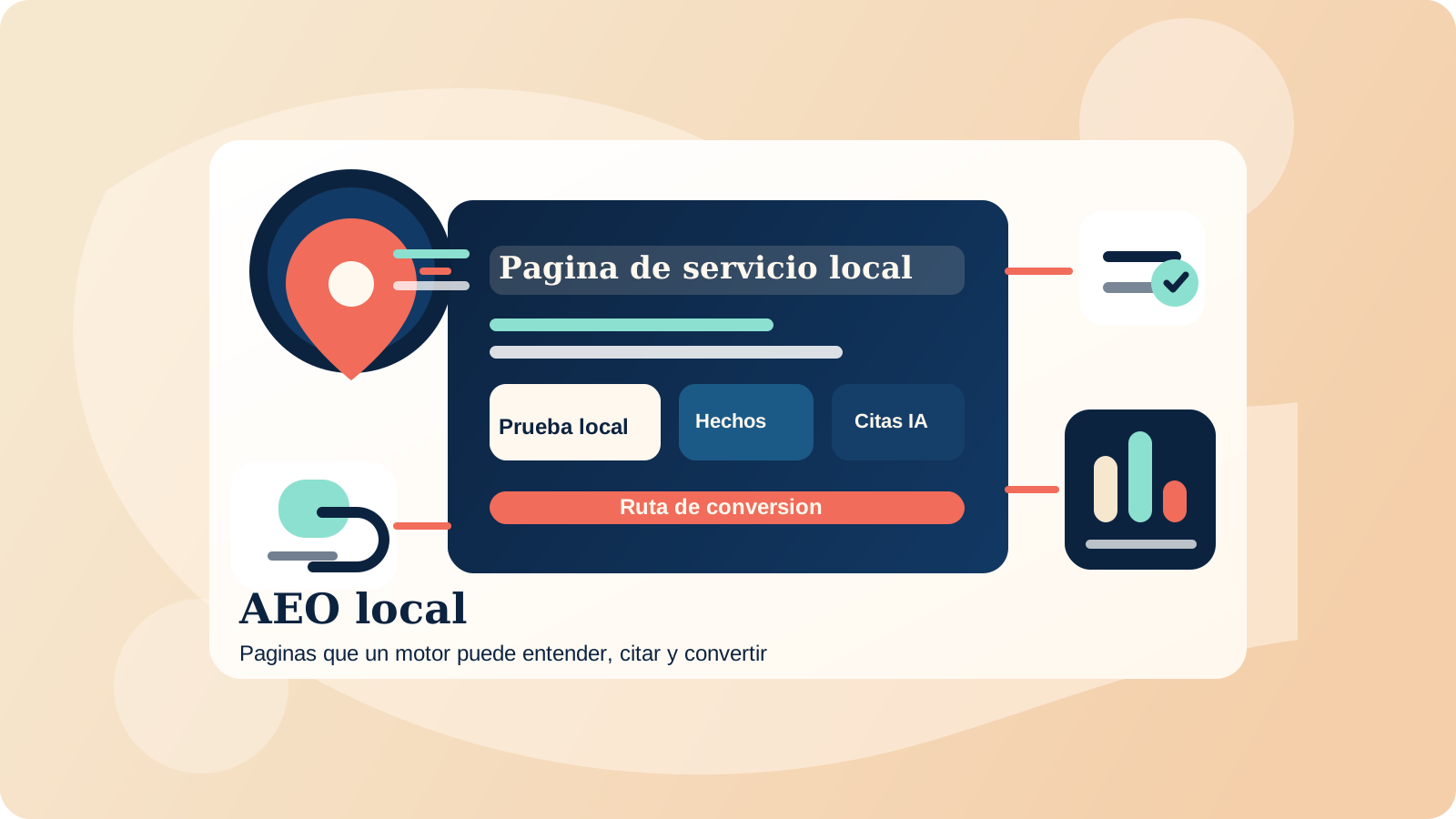
A lot of AEO content still looks too hard at blog posts and not hard enough at service pages. That is a mistake. If a company wants to appear as a credible option in local or commercial answer surfaces, the URL that matters most is often not an opinion article. It is a page that explains what the business does, for whom, in which area, with what evidence, and with what next step. That is where a strong service page stops being just local SEO and starts becoming a useful asset for answer engines.
Recent platform changes point in exactly that direction. Google has now published a dedicated guide for optimizing content for its AI experiences, and one of its practical themes is that systems understand content better when it is unique, satisfying, and easy to navigate, including local content. Bing already shows which pages get cited and for what query patterns in AI Performance. OpenAI leaves a measurable signal through ChatGPT search referral. Cloudflare adds more observability around formats, bots, and agent readiness. The conclusion is straightforward: the service page is back at the center.
If you need the base context first, we have already covered what AEO is, how to measure it without guessing and how to structure citable content. This piece brings that down to a very specific scenario: how to design local or commercial pages so they are easier to understand, reuse, and cite.
Why local service pages matter more than many teams think
Many teams still separate local SEO, commercial SEO, and AEO too aggressively. In practice, the boundaries are far more porous. An answer about the best provider, an agency near a searcher, or a company that offers a service for a specific type of business needs a URL that combines local context, service definition, trust signals, and operational clarity. If that information is scattered across the homepage, a blog post, and an external listing, the engine has more work to reconstruct it. If it lives cleanly on one strong page, reuse becomes more likely.
This kind of page is also much closer to business value than purely editorial content. A click from an AI answer into a well-built service landing page is worth much more than an ambiguous visit to a generic article. Adobe has been showing strong growth in traffic from AI sources, often with higher engagement than other channels. That does not make every visit valuable, but it does reinforce the need for landing pages that can continue the task the user already started in an answer engine.
Layer one: local and commercial proof without filler
The page should make it clear where the business operates, what kind of client it serves, and what practical outcome it delivers. Repeating the city name several times or cloning the same template across twenty municipalities is not the answer. That creates noise, weakens uniqueness, and can drift toward low-value scaled content. What does help is real local proof: meaningful geographic coverage, case examples, sector context, authentic FAQs, and details that commodity pages rarely offer.
At Blobic, that connects naturally with the methodology and content that shows decisions, blockers, and observable outcomes. That is what turns geography into evidence instead of a keyword.
Layer two: a service promise that is understood in seconds
The main URL should answer five questions fast: what do you do, for whom, in what context, how do you work, and what happens next? If those answers appear too late, stay hidden behind vague marketing blocks, or depend on stitching together too many ambiguous messages, the page weakens for search engines, users, and answer systems alike. Serious AEO does not reward ornamental copy. It rewards fast, reliable compression.
That means better ordering of headings, definitions, deliverable lists, service boundaries, concrete differentiators, and proof. A strong commercial landing page does not need to sound robotic. But it does need to be less vague than average. The less effort an engine needs to reconstruct the offer, the more likely that page is to become useful support for an evaluative or comparative answer.
Layer three: structured facts and non-commodity content
Google's new guide repeats an important idea: content that performs better in AI experiences usually adds something unique and satisfying instead of recycling interchangeable copy. On service pages, that translates into facts worth extracting: methodology, timelines, scope, work criteria, limits, examples, and sometimes directional pricing when it genuinely helps. If everything sounds like a hundred indistinguishable landings, eligibility may exist, but usefulness drops.
Structured data helps when it accurately describes what users can see. `Service`, `Organization`, `LocalBusiness`, `FAQPage`, or `BreadcrumbList` can reinforce interpretation, but they do not fix an ambiguous page. Visible clarity comes first. Coherent markup comes second.
Layer four: align text, images, and other formats
Bing has stressed that AI search works better when text, images, and video point in the same semantic direction. That also fits the logic behind Google's guidance and Cloudflare's added observability around content formats for bots and agents. For a service page, the implication is simple: the main visual, explanatory modules, descriptive captions, and any multimedia asset should reinforce the same promise the URL expresses, not distract with generic decoration.
That is why these landing pages benefit from custom diagrams, comparison tables, summarized processes, or explained screenshots more than from attractive but empty stock. Multimodal consistency is not just a design preference. It helps the page remain understandable even when a system processes it through different layers.
Layer five: a conversion path that continues the answer
When a visit comes from an answer engine, it rarely starts from zero. The user has already formed a need, already seen a summary, and often already ruled out part of the market. The landing page should continue that conversation, not restart it with a generic homepage. That is why it helps to connect the content to the next logical action: request an audit, review the methodology, inspect a case, or contact the team with a clear brief.
On this site, a post like this should also strengthen the project's own SEO. That is why it makes sense to link naturally to the methodology, the AI visibility audit and white-label AEO. This is not forced commercial copy. It is a way to strengthen the site's internal graph around local AEO, service pages, citable content, and commercial visibility.
Layer six: measure whether the page is actually being used
This is where the conversation stops being theoretical. Google now separates part of generative exposure in Search Console. Bing AI Performance shows citations, cited pages, and grounding queries. OpenAI lets you isolate ChatGPT search referral with `utm_source=chatgpt.com`. Cloudflare adds signals around bots, formats, and response statuses. Together, these sources help you understand whether a landing page is merely indexed, whether it starts gaining generative exposure, whether it is reused as answer support, and whether it attracts visits with enough intent to matter.
The hierarchy matters: first access and eligibility, then exposure, then citation, and finally business impact. If a local page does not move, review whether it returns a stable 200, whether it is indexable, whether the canonical is clear, whether the content answers a specific intent, and whether it adds something genuinely distinct. Only after that does it make sense to debate micro copy adjustments.
Common mistakes that make these pages weak
- Creating dozens of city pages with the same copy and only swapping place names.
- Using grandiose headlines without explaining process, scope, limits, or cases.
- Keeping local proof in PDFs, blog posts, or external listings instead of integrating it into the landing page.
- Marking up structured data that does not match the visible content.
- Sending AI traffic to a generic homepage instead of a URL that continues the intent.
- Measuring only visits and never checking citations, grounding queries, HTTP statuses, or landing pages.
A service page built for local AEO does not shout the city name louder. It reduces the distance between a concrete question and a confident decision.
Short checklist for a more citable service page
- Define the service, ideal client, area, and next step precisely.
- Add real local proof: cases, reasoned coverage, sector context, or observable outcomes.
- Summarize methodology, deliverables, and limits with headings that are easy to extract.
- Align images, text, tables, and supporting assets with the same commercial promise.
- Use structured data only when it matches what is visible.
- Measure access, generative exposure, citations, and qualified referral in one reading.
- Avoid scaled templates with no uniqueness or evidence of their own.
That is the standard worth aiming for now. Fewer cardboard local pages and more assets that a search engine, an assistant, and a buyer can understand with the same ease. If an agency needs to turn that criterion into a repeatable system for clients, our white-label AI visibility audit and white-label AEO service help identify which landings are already reusable, which are still too commodity-like, and which technical or editorial priorities should come first.
References
- Google Search Central: Optimizing your website for Google's AI experiences on Search
- Google Search Central Blog: A new resource for optimizing for Google's AI experiences on Search
- Google Search Central Blog: Introducing Search Generative AI performance reports in Search Console
- Bing Webmaster Blog: Introducing AI Performance in Bing Webmaster Tools Public Preview
- OpenAI Help Center: Publishers and Developers FAQ
- Cloudflare Changelog: AI Insights updates on Cloudflare Radar
- Cloudflare Fundamentals: Build for the agentic Internet
- Adobe Digital Insights: Q3 AI Traffic Trends Report