
AEO backlogs: how to turn Search Console and Bing AI Performance into priorities that actually move the business
A practical guide to using generative visibility reports, citations and technical access as one prioritization system for AEO and SEO.
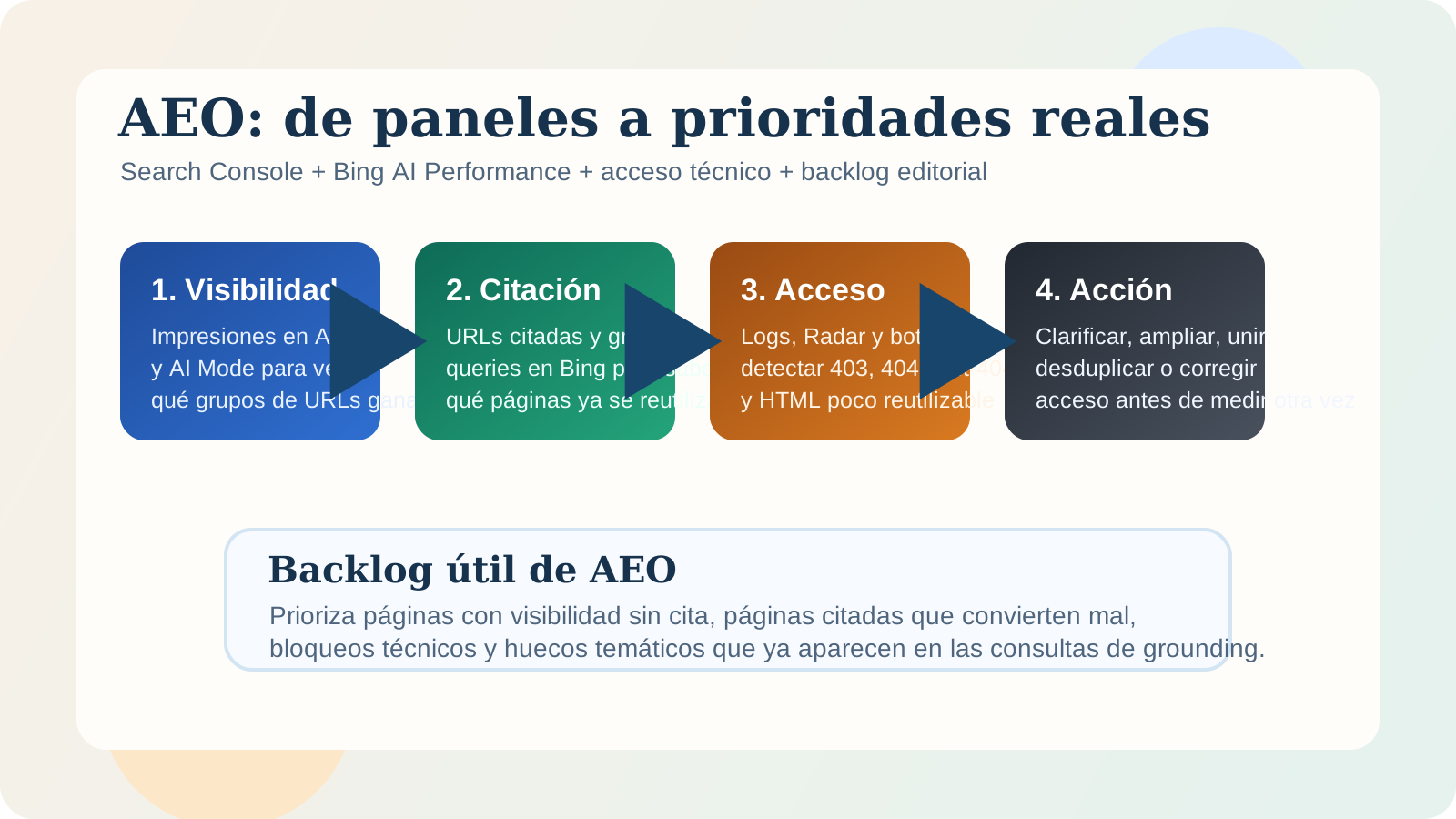
For too long, a lot of AEO work has looked like a mix of intuition, stray screenshots and claims that are hard to defend. That is changing. Google now provides dedicated generative-performance reporting in Search Console. Bing now exposes citations, cited pages and grounding queries in AI Performance. OpenAI leaves a measurable analytics signal with the utm_source=chatgpt.com parameter. Cloudflare Radar now surfaces more data on bots, agent standards and response statuses. The practical consequence matters: you can finally turn AI visibility into a real prioritization queue instead of folklore.
The mistake now is no longer a lack of data. The mistake is looking at each panel in isolation. If you want AEO to improve the business and also strengthen the portal's own SEO, you need one prioritization system that combines four layers: visibility, citation, technical access and actual conversion potential. That is the shift worth operationalizing.
If you want the base context first, we have already covered what AEO is, how to measure it without guessing and how to structure citable content. This article focuses on the next step: how to decide which URL to work on first.
Layer one: visibility without obsessing over the total
Google's new generative reports are useful, but easy to misread. They are not there so you can brag about a raw impression count. They are there to show which page groups appear more or less in AI Overviews, AI Mode or other generative surfaces, which thematic patterns gain traction, and which changes coincide with stronger or weaker exposure. In other words, Search Console gives you a discovery signal, not an automatic editing order.
- Group URLs by function: method, audit, resources, blog and transactional pages.
- Compare before and after concrete structural or editorial changes.
- Do not confuse more impressions with more value if the visible URL does not move a user toward a useful decision.
- Treat visibility changes as an investigation trigger, not as a final verdict.
Layer two: citation shows which pages already do source work
Bing AI Performance adds a piece that used to be missing: not only whether you appear, but which exact URL is reused as support for an answer. That changes the backlog. A page with generative visibility but no citations may need more clarity, better structure or a more direct answer. A page with recurring citations but weak commercial orientation may be supporting demand without channeling it well. A page cited for unexpected queries may reveal a new editorial opportunity.
Grounding queries are especially useful here. They are not a perfect or complete list, but they are an operational sample of how the system frames your content. If an audit page is connected to provider-comparison queries, it may need more visible tables, limits, deliverables and proof. If an informational guide gets cited in transactional questions, internal links toward service pages matter even more.
Layer three: technical access so you do not optimize pages bots receive badly
Many AEO backlogs fail for a basic reason: they prioritize copy when the real problem is access. Google keeps saying that inclusion in its AI features still depends on solid SEO foundations. OpenAI makes ChatGPT search traffic traceable. Cloudflare Radar now makes bot response behavior easier to inspect. If a key URL returns 403s, 404s, soft 404s, unstable HTML or contradictory bot policy, any editorial improvement starts from a weaker position.
- Check that priority URLs return real 200s to bots and browsers.
- Verify that visible content aligns with canonicals, snippet controls and structured data.
- Separate training-bot policy from search-bot policy; those are different decisions.
- Identify pages where the key answer is trapped in formats that are poor for extraction or reuse.
Layer four: business capacity, not only appearance capacity
Not every page that gains exposure deserves to go first in the queue. For a site like Blobic, the real priority combines visibility signal with commercial value. An informational URL may deserve work if it sits one logical click away from the AI visibility audit or white-label AEO. But if a page gets exposure and connects to no decision path, architecture, CTA framing, comparison content or service context may need attention before more copy work.
This also improves classic SEO. When an informational piece connects more clearly to method, audit, resources and transactional pages, it becomes more useful inside the domain's topical network. That is not keyword stuffing. It is building a more coherent internal graph for search engines, assistants and users.
A simple backlog model for AEO
- Visibility without citation: pages Google exposes but answer engines barely reuse as sources. These usually need clearer structure, stronger evidence or better chunking.
- Citation without conversion: pages already reused by answer engines, but weakly connected to service pages or a blurry offer.
- Access-blocked potential: strong-intent URLs held back by technical, canonical, snippet or bot-control issues.
- Confirmed topic gap: grounding-query or demand patterns where the domain still lacks a specific, citable answer.
Where Markdown for Agents fits without the hype
This is where precision matters. Markdown for Agents is not a magical ranking lever. But it does fit as a friction-reduction layer: negotiable markdown, lighter responses, more predictable structure and preserved JSON-LD. If a page is already good, it may make reuse easier for agents. If the page is weak or ambiguous, it will not rescue it. That is why it should enter after the backlog is ordered, not instead of ordering the backlog.
What kind of post belongs on an AEO portal like this
Exactly this kind. A post that does not just repeat definitions, but turns real ecosystem changes into an actionable method. That helps the reader, improves the site's organic visibility and reinforces terms that align with the offer: AEO, AI visibility, Search Console, Bing AI Performance, AI Overviews, AI Mode, ChatGPT search and answer engine optimization. Publishing content like this does more than inform. It demonstrates operational judgment.
In AEO, the best backlog does not start with a keyword. It starts with the URL that already shows signal but still is not doing all the work it could do.
That is the useful standard now. Fewer isolated screenshots, more defensible decisions. If an agency needs to build this system across several clients without standing up a full internal answer-engine team, our white-label AI visibility audit is the fastest way to identify which URLs already carry signal, which fail on access, which need more citable content and where the next push should happen.
References
- Google Search Central Blog: Introducing Search Generative AI performance reports in Search Console
- Google Search Central Blog: A new resource for optimizing for generative AI in Google Search
- Google Search Central: AI features and your website
- Bing Webmaster Blog: Introducing AI Performance in Bing Webmaster Tools Public Preview
- Microsoft Advertising: The AI Performance dashboard: your view into where your brand appears across the AI web
- OpenAI Help Center: Publishers and Developers - FAQ
- Cloudflare Fundamentals: Markdown for Agents
- Cloudflare Changelog: AI Insights updates on Cloudflare Radar