
Query fan-out in GEO / AEO: how to cover the subquestions behind AI search
A practical guide to understanding query fan-out in AI search and turning it into a content, internal linking and citable-source strategy for GEO / AEO.
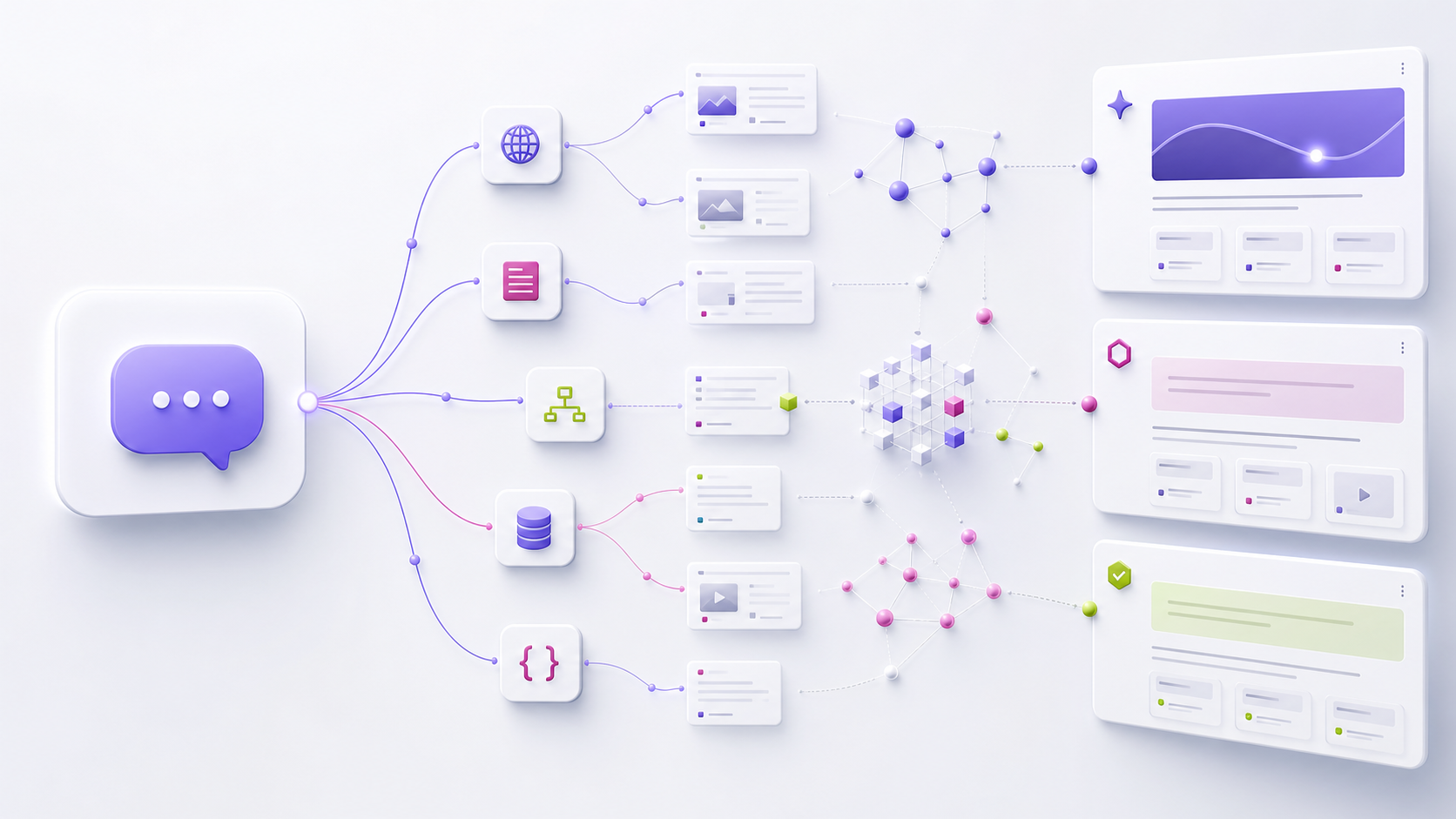
AI search rarely behaves like a linear query. When someone asks Google AI Mode, AI Overviews, ChatGPT Search, Perplexity, Gemini, Claude, Copilot or Bing for a recommendation, comparison or diagnosis, the system may need to solve several subquestions before composing the final answer. That expansion is what Google calls query fan-out: generating related queries to retrieve more information and cover the user's intent more completely.
For a business, this changes how GEO / AEO should be planned. Creating one page for one main keyword is not enough. Teams need to understand which secondary questions support the answer, which sources can prove each claim and which owned URL should be the clearest candidate to be cited or recommended.
In GEO / AEO, query fan-out means that one initial question can trigger several internal searches across subtopics, criteria, proof points and sources before a generative engine builds an answer.
Why it matters for AI visibility
Query fan-out matters because many generative answers do not rely on one exact-match result. A system may decompose a question like “which agency can help me appear in ChatGPT” into subquestions about services, methodology, proof, location, specialization, pricing, reputation, comparisons and technical signals. If the website answers only one part, the AI system may complete the rest with competitors or external sources.
Google explains that its generative experiences still rely on search, retrieval and quality systems, and that pages should be crawlable, useful, well organized and eligible to appear with a snippet. Bing now organizes AI visibility around intents, topics and citation share. The practical takeaway is clear: answer engines do not only look at one isolated URL; they try to understand a topic, its proof and its relationships.
How to turn one question into a subquestion map
The first step is not writing more. It is decomposing better. Every important commercial question should become a small subquestion map that explains what an AI system would need to verify before answering accurately.
- Initial question: how a potential customer would ask it in a conversational assistant.
- Main intent: learn, compare, diagnose, choose a provider, validate trust or complete an action.
- Informational subquestions: definitions, differences, limits, criteria and common mistakes.
- Commercial subquestions: scope, deliverables, process, indicative pricing, timing, customer fit and contact path.
- Proof subquestions: cases, methodology, external sources, mentions, structured data, profiles and entity signals.
- Candidate page: the owned URL that should support the main answer.
- Supporting content: articles, resources, definitions or service pages that cover specific subtopics.
This connects directly with a GEO / AEO intent map. The difference is that query fan-out forces the team to look at which pieces the complete answer needs, not only which prompt should be measured.
Example for a GEO / AEO agency
Take the question “how do I prepare my company to appear in AI answers”. A reliable answer cannot stop at saying that content should be optimized. The system may need to resolve what GEO / AEO is, which pages should exist, how visibility is measured, which crawlers should be allowed, how structured data helps and which external signals make the brand credible.
The candidate page could be an AI visibility audit if the intent is diagnostic. Then the site should link to supporting content on citable answer blocks, citation share, llms.txt or structured data when each piece adds real proof.
A page prepared for query fan-out does not try to answer everything superficially: it answers the main intent and links to the specific proof that completes the response.
What a company should review on its website
The review should combine content, architecture and technical access. If an important subquestion has no clear URL, the AI system must reconstruct the answer from scattered fragments. If the URL exists but is not internally linked, it is harder to find. If the content is blocked, hidden or inconsistent with structured data, the trust signal weakens.
- Crawling and indexing: make sure candidate pages are available to search engines and, when relevant, to AI search crawlers such as OAI-SearchBot or Perplexity systems.
- Internal architecture: make sure main pages link to guides, resources and posts that resolve subquestions.
- Semantic clarity: titles, headings, definitions and visible copy should explain entities, services and criteria without ambiguity.
- Verifiable proof: important claims should be backed by methodology, examples, sources, data or related pages.
- Structured data: markup should describe what users can actually see on the page, not promise nonexistent information.
- Bilingual parity: Spanish and English versions should answer the same intent and link to their direct equivalents.
How to create content without duplicating pages
A common mistake is treating query fan-out as permission to create a page for every tiny search variation. That can produce repetitive, weak and hard-to-maintain content. The better approach is to group subquestions by intent and decide whether each one needs a section inside a main page, a supporting article or an independent page.
If the subquestion helps a buyer make a commercial decision, it may deserve a strong URL. If it only clarifies a concept, it can work as an answer block inside a guide. If it requires technical proof, it may belong in a specialized post. The criterion is not keyword volume; it is usefulness, citability and connection to the user's next action.
How to measure whether the map is working
Measurement should check whether the brand appears in more answers, whether the cited URL is the right one and whether engines group the company under the right topic. In Bing Webmaster Tools, AI reporting already points toward intents, topics, citations and time comparison. In Google, teams should combine Search Console, Analytics, logs, conversions and manual prompt reviews because visits from generative experiences are integrated into search performance.
- Main prompts and subprompts reviewed by engine.
- Brand presence: mention, citation, recommendation or absence.
- Expected URL versus actually cited URL.
- Subquestions the answer covers well and subquestions a competitor covers better.
- External sources that appear as proof for the brand or category.
- Priority action: create a section, improve internal links, strengthen a source, correct data or review crawling.
Conclusion: design for compound answers
GEO / AEO is the set of practices designed to improve the visibility of a brand, website or content in generative engines, conversational assistants and AI-based answer systems. Query fan-out adds one key idea: many answers do not come from a single question, but from a network of subquestions the system tries to resolve at the same time.
At Blobic, we use this logic to turn existing SEO into an answer architecture: main questions, subintents, candidate pages, internal links, verifiable sources and measurement by engine. If you want to know which subquestions your company needs to cover to be cited in AI answers, an AI visibility audit helps prioritize the work with GEO / AEO and business criteria.
References
- Google Search Central: Optimizing your website for generative AI features on Google Search
- Google Search Central: AI features and your website
- Bing Blogs: New AI Visibility Insights in Bing Webmaster Tools
- OpenAI documentation: Overview of OpenAI Crawlers
- Perplexity documentation: Perplexity Crawlers
- Google Search Central: General structured data guidelines